The useful starting point
Power returning is one milestone. Keep a project record that explains what changed, what remains and how the owner uses the equipment.
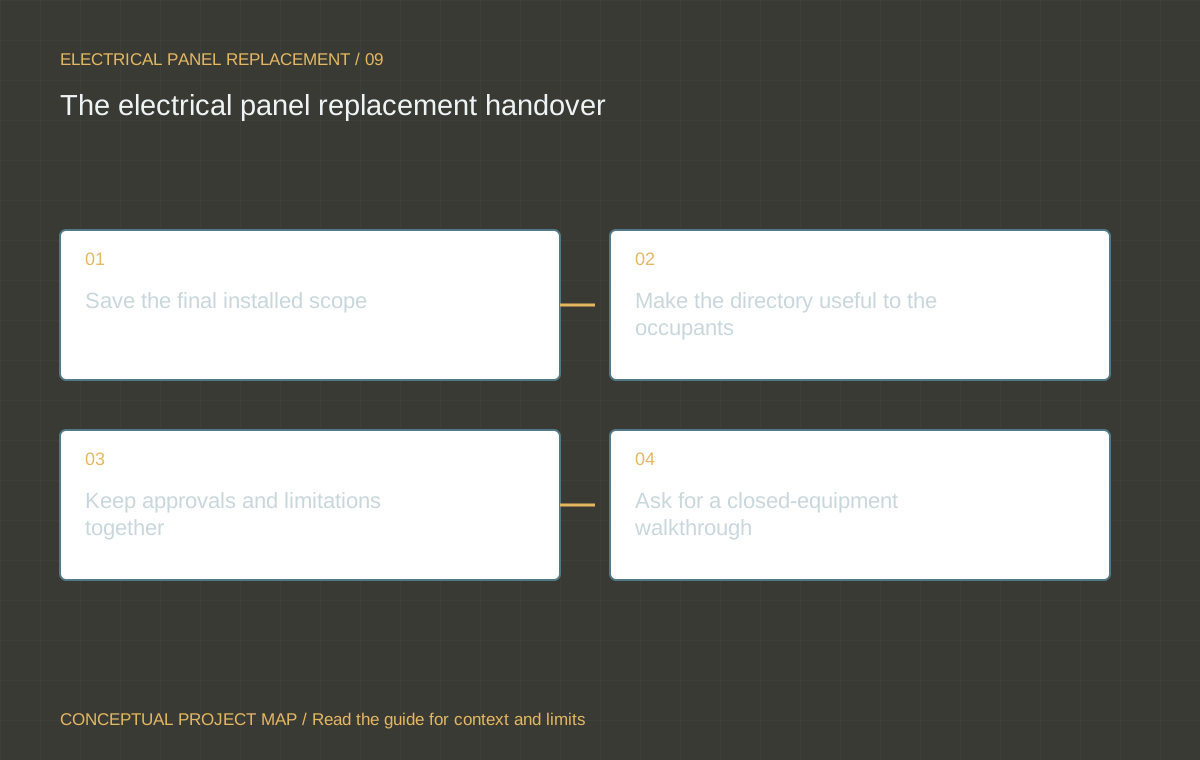
Save the final installed scope
Request a final record of replacement and retained equipment. Keep any variations from the accepted proposal with the reason and authorisation. A future contractor should be able to see whether the service capacity changed, which circuits were renewed and which parts remained.
Save product identification, manuals and warranty documents. If configured equipment or management controls are included, record final settings and who can alter them. Do not publish private permit documents or property details in an online review.
Make the directory useful to the occupants
Ask the contractor for an accurate circuit directory using meaningful room and equipment names. Ambiguous labels such as plugs or spare can be misleading. Tell the contractor about the household's normal room names so the directory is understandable.
Do not independently open equipment or trace concealed circuits to validate the directory. Ask for clarification as part of the handover. Preserve a readable copy with the project records, especially when a later renovation may change room use.
Keep approvals and limitations together
Obtain the applicable permit number and inspection outcome from the responsible permit holder. An invoice and inspection documentation serve different purposes. If items remain open, record the owner, next action and what use is permitted while they are resolved.
Alberta's current code gateway identifies the installation code in force, but a website reference does not approve your project. Retain the actual authority's project outcome and supporting documentation.
Ask for a closed-equipment walkthrough
Request an explanation of normal indications, accessible owner controls and the response to a returning symptom. Follow product instructions for any owner testing or operation. Make no assumptions that every device has the same control or reset procedure.
For management or backup systems, understand the operating priorities, restrictions and process for equipment changes. Keep the support contact and manual where another occupant can find them. Owner training should not require exposing energized parts.
Leave the next owner a clearer record
Keep the assessment, accepted scope, variations, invoices, equipment documents and authority outcome in one property folder. Mark any future scenarios as assessed, considered but not approved, or not assessed. Avoid a loose phrase such as ready for everything.
If a symptom returns, use the findings and handover to describe it accurately. Review the roadmap to distinguish original findings from later changes. A complete record supports maintenance; it does not guarantee future suitability indefinitely.
Questions / Direct answers
Common questions
Is an invoice enough proof of completion?
It records a commercial transaction. Keep applicable inspection outcomes, installed scope and equipment documents separately.
What if some work is still open?
Record the issue, responsible party, next action and any restrictions rather than treating it as closed.
Should I keep the old service information?
Yes. A before-and-after record clarifies whether capacity changed and which equipment remains.
References / Jurisdiction matters
Sources & further reading
Confirm the actual location, permit authority and equipment instructions before relying on a requirement. A source from another jurisdiction is identified for context.
- Electrical codes and standardsGovernment of Alberta · 2026-10-07
Do not open equipment, handle refrigerants or work on energized systems. Permits, qualified trades and inspection requirements vary by location. This guide does not design an installation or certify existing equipment.