The useful starting point
A new enclosure is one part of a replacement. Start with findings, then define the equipment, approvals, outage and handover.
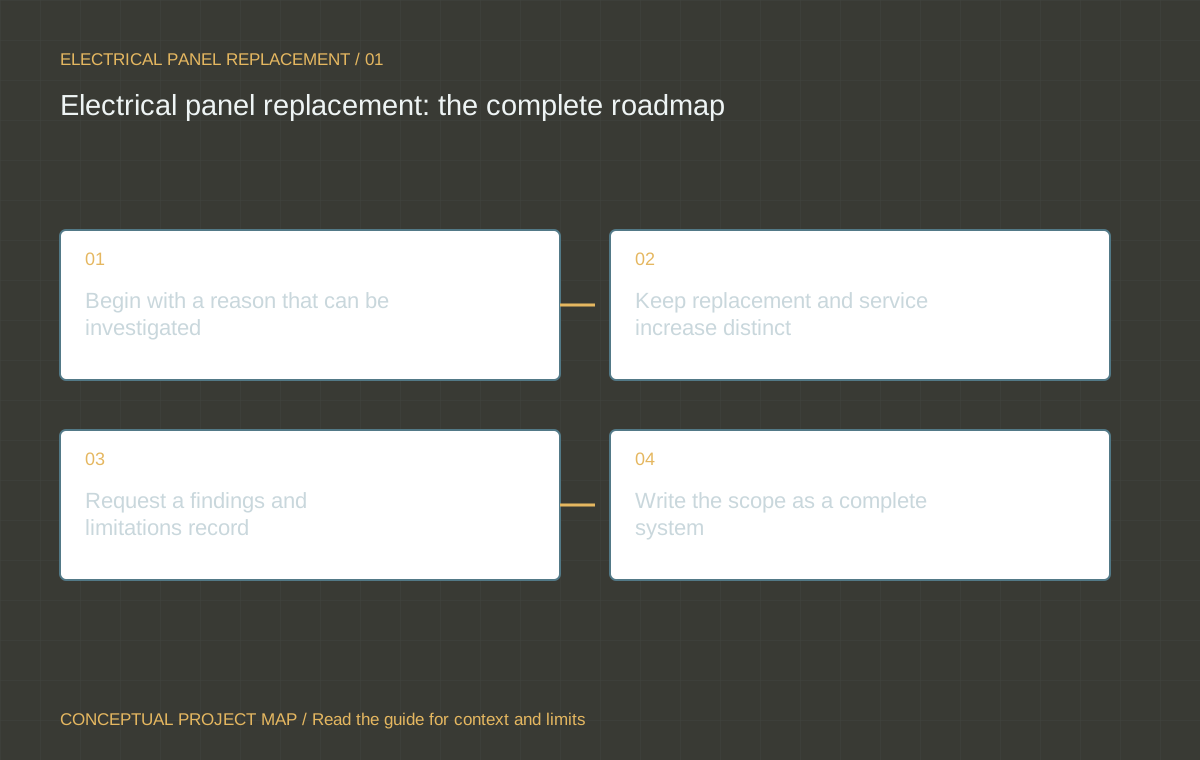
Begin with a reason that can be investigated
Electrical panel replacement is often discussed as a product purchase. The owner chooses a new panel and expects the electrician to swap it. A more useful starting point is the problem: visible damage, an investigation finding, inadequate distribution space, difficulty obtaining suitable parts, a relocation or a planned service increase. Each reason creates a different scope. A new product does not automatically resolve every underlying condition.
Record why replacement has been proposed and who made the recommendation. If it came from a property inspection, insurer, renovation designer or electrician, ask for the written finding and any limitations. A recommendation to obtain further assessment is not the same as a diagnosis. Do not treat the brand, age or appearance of an enclosure as a complete technical conclusion.
When there is smoke, fire, shock or immediate danger, move away and contact emergency services. Planning can follow after the immediate condition is addressed. Do not open suspect equipment or repeatedly reset protective devices to establish a stronger symptom record. Panel work and investigation belong with qualified people.
Keep replacement and service increase distinct
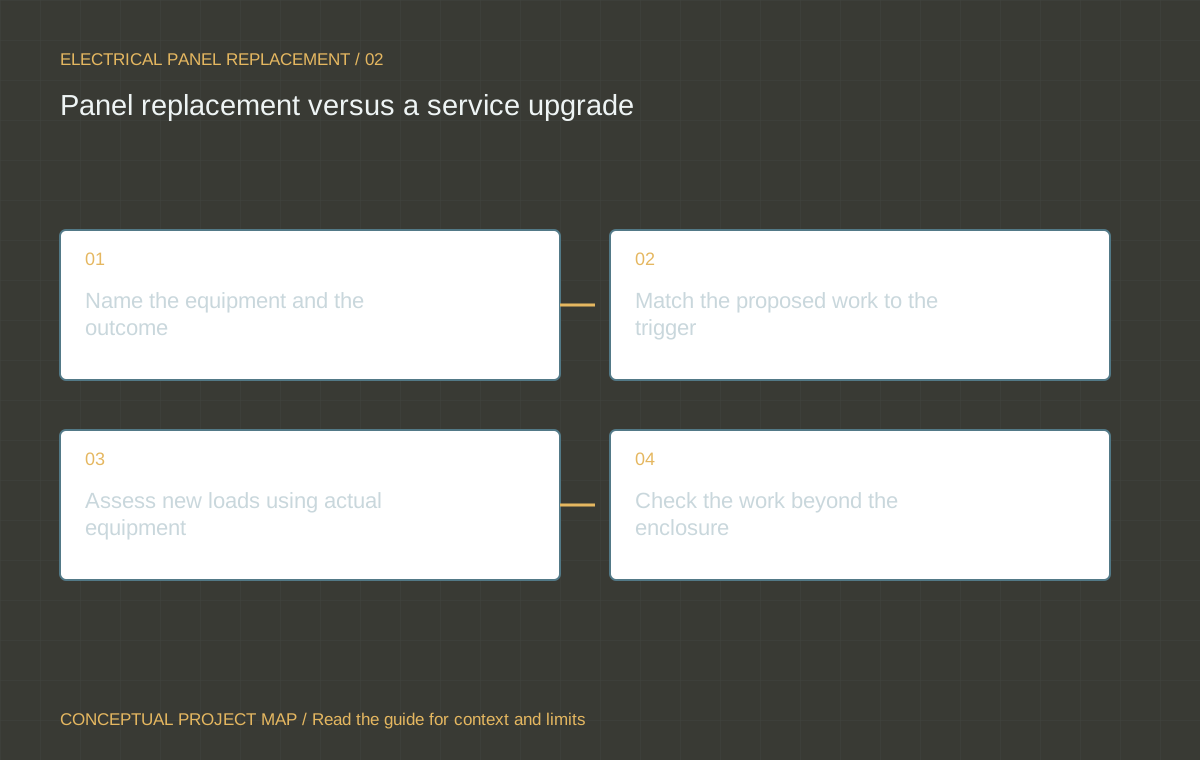
A panel replacement changes distribution equipment. A service increase changes the supply capacity through the complete approved arrangement. They may be part of the same project, but one does not imply the other. A quote can supply a panel rated above the existing service while leaving the supplied capacity unchanged.
Ask the contractor to state the existing service, the proposed service and the basis for the recommendation. If future equipment is part of the reason, include the actual appliance, charger, heating or spa specifications. If the purpose is condition repair, ask whether the supply capacity remains suitable for the current loads. A homeowner should not have to infer the electrical outcome from a product name.
Other work can sit between a panel and a full service change: circuit additions, suitable distribution changes, equipment relocation or a subpanel. Have the proposal explain why each item is required. A bigger box is not an alternative to assessing the complete installation, and a new panel does not mean the property's branch wiring is new.
Request a findings and limitations record
The assessment should identify equipment condition, installation suitability, existing circuits and the project constraints relevant to the proposed work. Where the contractor has not yet accessed concealed areas or coordinated with the utility, ask that those limitations be recorded. An initial quote can be conditional without being vague.
Ask what the replacement will correct and which findings remain outside scope. If there is evidence of heat or water exposure, ask how affected equipment beyond the enclosure is assessed. If circuit identification is unclear, agree whether tracing and directory correction are included. If future demand is the trigger, ask for the capacity assessment reference.
Leave covers in place when collecting information. Accessible labels, existing records and photographs from normal safe access provide context. They cannot establish hidden connections, internal damage or compatibility. Keep the distinction between an owner observation and a professional finding in every document you send.
Write the scope as a complete system
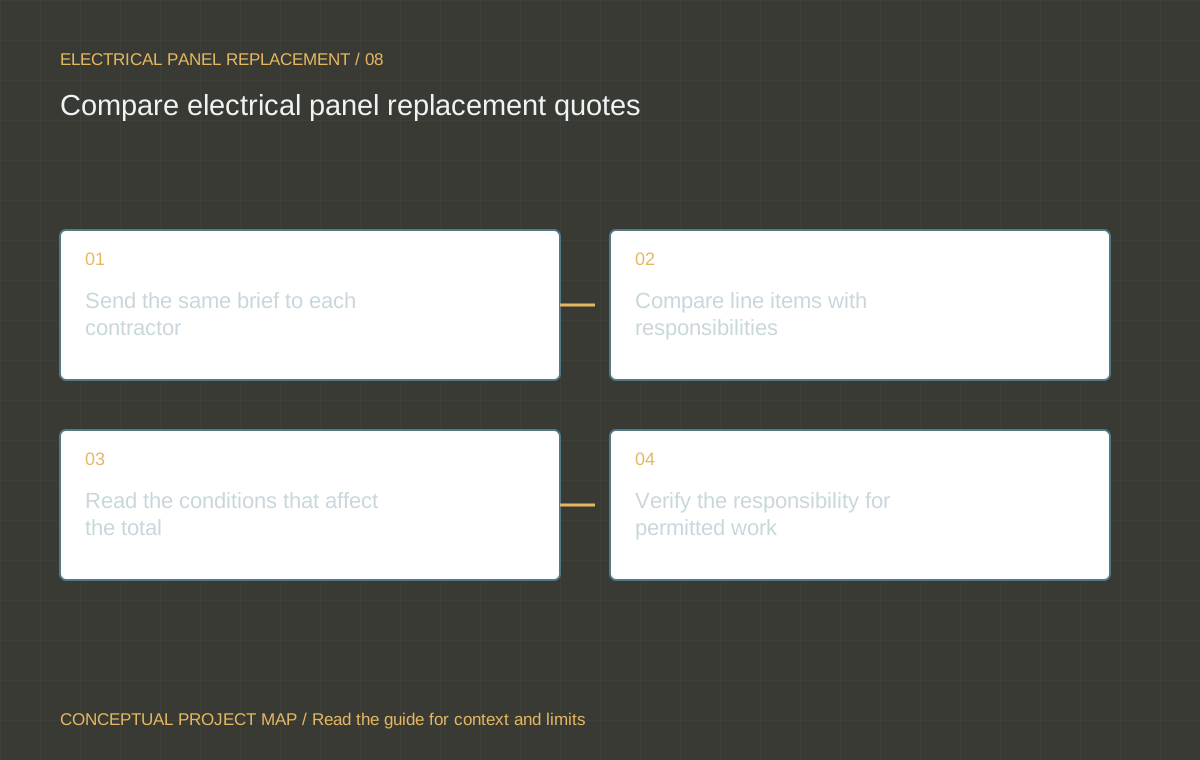
A useful written scope identifies the replacement equipment, retained equipment, circuit work, any service changes, access requirements and surface restoration. It names permits, inspection arrangements and utility coordination where applicable. The owner can then compare proposals that describe the same outcome rather than two totals for different projects.
Ask how equipment compatibility is established. An apparently similar protective device or component should not be substituted merely because it fits. Request product identification and appropriate installation information. Health Canada explains Canadian certification marks for consumer electrical products; a contractor must also establish the suitability and approval of the actual fixed equipment used in the project.
If opening walls, modifying service equipment or correcting discovered defects is excluded, keep that exclusion beside the price. Agree how additional work is authorised. A contingency process with documented findings is more useful than a promise that no surprises will occur.
Coordinate the authority and utility
Identify the permit authority for the actual address. Calgary and Edmonton publish separate permit processes and homeowner limitations. Calgary excludes main-service alterations from homeowner electrical permits; Edmonton restricts installing or relocating main-service equipment for homeowners who are not certified master electricians. Do not carry either city's procedures into another municipality without checking.
Ask who obtains the permit, arranges inspections and provides the outcome. The Safety Codes Council explains the master electrician's permit responsibility. Confirm the responsible permit holder rather than accepting an assurance that paperwork is handled.
Utility work and inspection work may have separate bookings. A temporary disconnect and reconnect is not automatically the same process as a supply increase. If capacity changes, use the distributor's current process. Do not assume a scheduled electrician visit means every other dependency is ready.
Plan the outage as an owner task
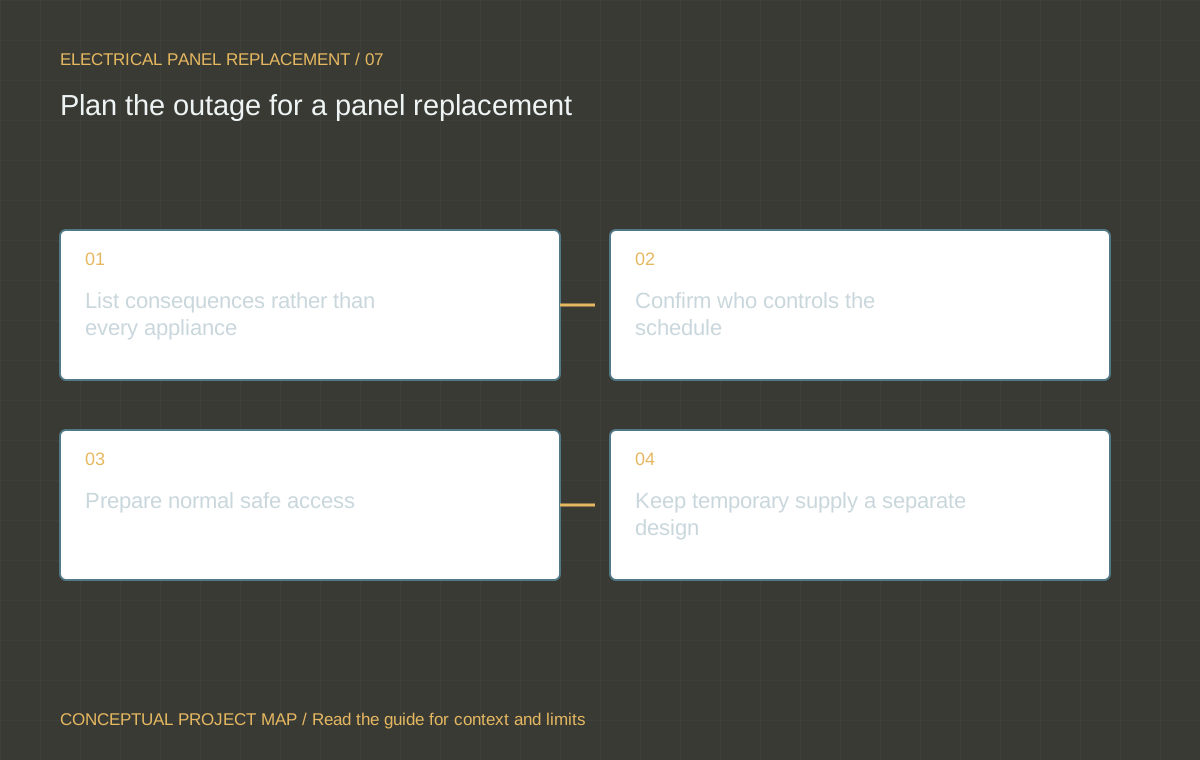
List anything that makes loss of electricity consequential: medical equipment, refrigeration, heating, home-office commitments, powered doors, security and access systems. Tell the contractor early. Ask for the expected working window, what is still conditional and who will communicate a delay. Do not treat an estimate as a guaranteed outage duration.
For a business or shared building, include occupants and operational responsibilities. Who authorises shutdown? Who checks affected equipment after re-energization? Who communicates a schedule change? Assign those responsibilities before work begins rather than leaving the electrician to discover critical operations on arrival.
Any backup-power arrangement must be assessed separately. Do not improvise a generator connection or backfeed through an outlet. A consumer battery or UPS may support a specific device according to its instructions; it does not make an arbitrary temporary building supply safe.
Define completion before signing
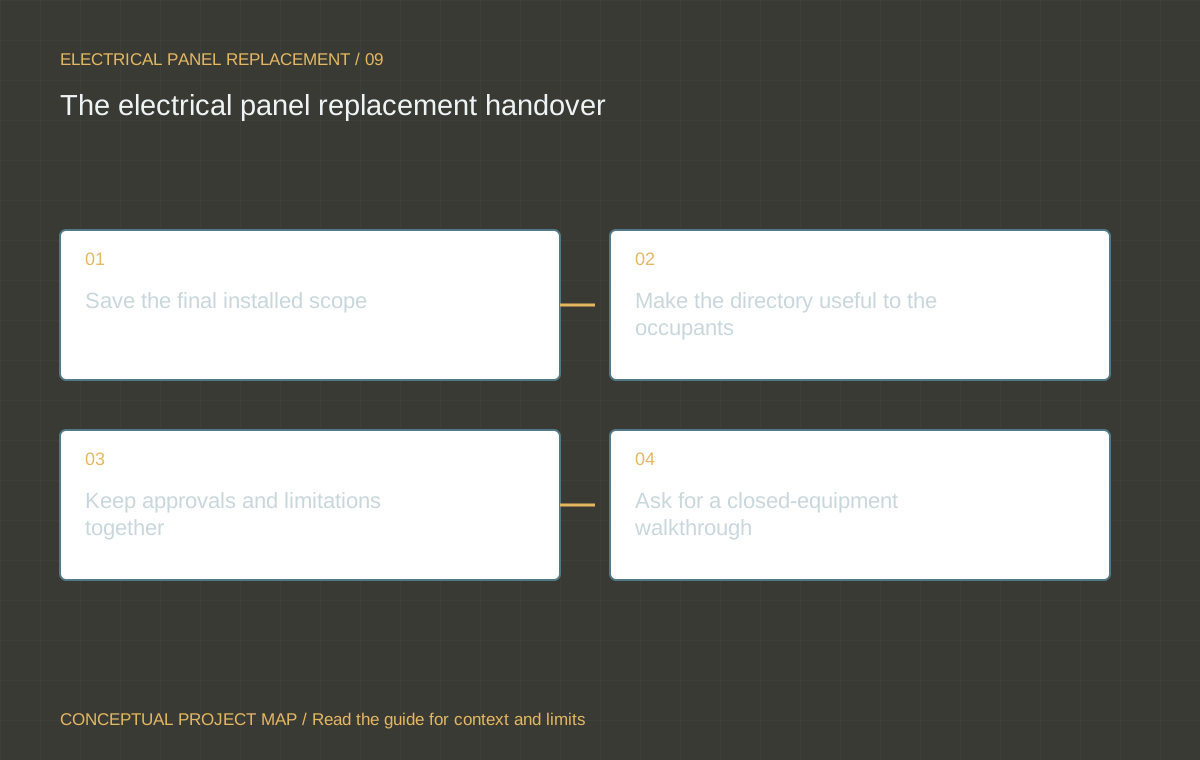
Agree on the project records: applicable permit and inspection outcome, equipment identification, accurate circuit directory, manuals, final settings and a list of remaining items. If service capacity changed, keep the confirmed final arrangement and utility scope. If it did not, record that plainly.
Walk through owner controls and normal indications with the contractor without opening equipment. Ask who handles a returning symptom and what documentation is needed for a warranty request. A receipt saying panel installed is not as useful as a handover that explains what was assessed, changed and left in service.
Use the scope builder to organise the request. The quote guide helps compare proposals, while the handover guide defines the final record. HAUSE intake records an enquiry; it does not certify an installation or promise a contractor's availability.
Questions / Direct answers
Common questions
Is panel replacement the same as upgrading to a larger service?
No. Ask for the existing and proposed service capacity separately from the replacement panel specification.
Does replacing the panel mean the house is rewired?
No. Branch circuits can remain in service. The proposal should state what is inspected, replaced and retained.
Can I replace the main panel under a homeowner permit?
Main-service work has specific restrictions. Confirm the actual project with the local authority and use the appropriate qualified contractor.
How long will power be off?
The contractor, utility scope, inspection dependencies and site conditions determine the schedule. Ask for an estimate and contingency; this guide offers no universal duration.
What should I receive when work is finished?
Keep the applicable permit outcome, equipment documentation, accurate directory, final arrangement and unresolved-item record.
References / Jurisdiction matters
Sources & further reading
Confirm the actual location, permit authority and equipment instructions before relying on a requirement. A source from another jurisdiction is identified for context.
- Homeowner electrical and plumbing permitsCity of Calgary · 2026-10-07
- Electrical permits — residentialCity of Edmonton · 2026-10-07
- About master electriciansSafety Codes Council · 2026-10-07
- Electrical product safetyHealth Canada · 2026-10-07
Do not open equipment, handle refrigerants or work on energized systems. Permits, qualified trades and inspection requirements vary by location. This guide does not design an installation or certify existing equipment.