The useful starting point
Make an equipment-specific decision. A brand name, online reputation or visually similar breaker is not a complete assessment.
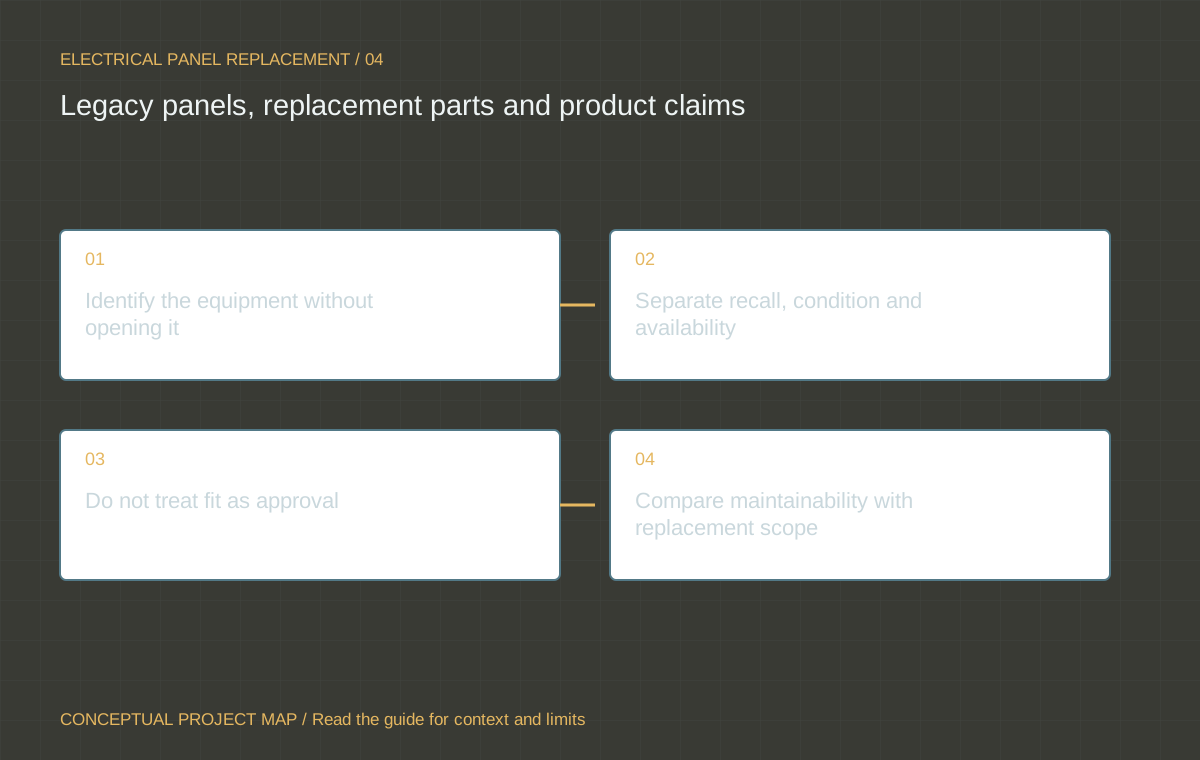
Identify the equipment without opening it
Provide accessible product labels, previous invoices and records to the electrician. Keep covers in place. A brand may have multiple product families and revisions, and a previous owner may have altered the installation. A name alone is insufficient for a product-specific conclusion.
Ask the contractor to state exactly which equipment was identified and which details still need confirmation. An assessment that names the panel, relevant components and observed condition is more useful than a broad recommendation about all old panels.
Separate recall, condition and availability
A product recall is a specific published action covering identified products. An equipment-condition finding concerns the actual installation. A difficulty sourcing suitable parts is a maintenance issue. Keep these matters separate rather than using one to imply the others.
Ask anyone relying on a recall or manufacturer notice to provide the exact primary document and applicable product identification. This library does not publish unsupported brand-wide failure claims or diagnose a panel from a photograph.
Do not treat fit as approval
A visually similar breaker or component may not be suitable for a panel. The contractor needs to establish compatibility and approval using the relevant equipment information. Owner shopping for an apparently matching part can create a misleading basis for a repair decision.
Ask whether the proposed work restores the equipment with suitable parts or replaces the assembly because that path is better supported. If a repair option is rejected, request the reason and its evidence. Price alone does not determine whether an unsuitable substitute can be used.
Compare maintainability with replacement scope
A replacement may provide a clearer maintenance path, suitable distribution for planned work and a documented handover. It can also introduce outage, access and circuit-correction scope. Compare those outcomes with an assessed repair, where repair is an appropriate option.
A contractor should identify limitations: uncertain concealed work, unavailable documentation or required investigation. Avoid assurances that a new panel resolves every old-house wiring concern. Retained circuits and devices still matter.
Keep the rationale
Save product identification, the primary notice if one applies, findings, rejected options and the agreed scope. This allows a future owner or contractor to understand why replacement was chosen. An invoice with a brand name and total is a thin substitute for that record.
Use the quote comparison and handover guide. Do not remove or replace components as an owner investigation.
Questions / Direct answers
Common questions
Is every panel of a particular age or brand unsafe?
A universal claim needs product-specific primary evidence. Obtain assessment of the actual installation and any applicable official notice.
Can I buy a similar breaker online?
Have the qualified contractor establish suitable components; appearance and physical fit are insufficient.
What if suitable parts cannot be obtained?
Ask the electrician to document that limitation and compare a supported replacement scope.
References / Jurisdiction matters
Sources & further reading
Confirm the actual location, permit authority and equipment instructions before relying on a requirement. A source from another jurisdiction is identified for context.
- Electrical codes and standardsGovernment of Alberta · 2026-10-07
- Electrical product safetyHealth Canada · 2026-10-07
Do not open equipment, handle refrigerants or work on energized systems. Permits, qualified trades and inspection requirements vary by location. This guide does not design an installation or certify existing equipment.